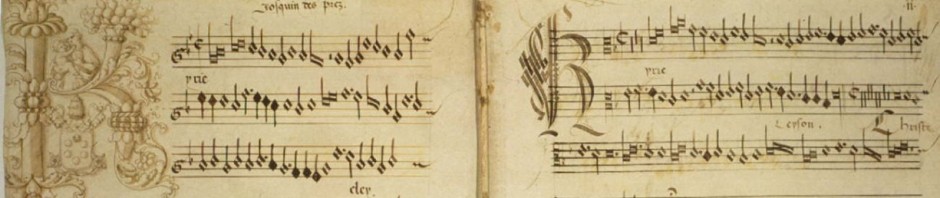
Most common rounds or canons are “canons at the unison” meaning that each part is the same and starts on the same note just at different times. For instance, “Row, row, row your boat “ is a canon at the unison. The first part starts “Row, row, row your boat,“ then the 2nd part comes in on “Row, row, row your boat,“ on the same note and tune that the first part started. But canons are not always “at the unison.”
For instance, in Thomas Ravenscroft’s collection of songs and rounds or catches called Pammelia: Musicks Miscellanie, published 1609, canon number 13, “Hey downe a downe,” is a canon at the fifth. This means that each part starts their repetition of the tune a fifth above the previous part. This makes it a convenient round for several people with various voice ranges. In this case the lowest part, the bass, starts, the tenor comes in a measure later a fifth above where the bass started, and another measure later the treble comes in a fifth above where the tenor started, or, in other words, a ninth above where the bass started.
The original published version is here (it is the second one on the page):
https://www.pbm.com/~lindahl/ravenscroft/pammelia/pam_09small.html
Here is a modern version with each part written out:
And here is what the modern version sounds like:
Note: “trole” in this case could mean either “sing to” or “pass around” – since “the berry” is likely wine, it could be both.

 pastyme